Showing posts with label Arts. Show all posts

01 December 2013

Sue Bamford web site

I have, at intervals, several times made mention here of my admiration for the work of Dublin artist Sue Bamford and have, since her exhibition last December, spent many hours lost in examples of her work on the walls of my home.
She has, as I write this, a weekend "at home" exhibition. She also, I'm delighted to say, has a new stand-alone web site (separate, that is, from her Facebook page) carrying galleries of her work.
One of the galleries is given over to the landscapes which I love so much – including, I'm quietly chuffed to see, Estuary in winter which I was lucky enough to buy in her December 2012 show.
Another contains, amongst other drawings, examples (here, here and here) from the sequence of drawings which I mentioned (see "Drawing from the hip") back in January, which so strongly call out to the observational photographer in me: her Dubliners sequence of street drawings from a personal James Joyce project, each framed in the wing mirror of her car.

30 November 2013

To the Crabmobile!

We blog writers all, at some time (or times) hit fallow spells when we write little for a greater or shorter length of time. I'm in one of them, recently. And we all have our excuses (as Jim Putnam says: “excuses are like elbows: everyone has a couple”).
Nobody, however, but nobody, worries about it more, or has more genuinely watertight reason, than Dr C: a man of deep morals, developed conscience, and commitment to his patients – especially those who are children. There are few bloggers for whom I feel the admiration, respect and affection which I have developed over the years for Dr C ... nor from whom I so vehemently refuse remorseful apologies for silence – which is always down to overwork on behalf of others.
In Dr C's coastal community, crabbing is an important component of local industry. One of the stratagems which he uses to put his youngest patients at ease is to ask them to make  drawings of crabs – some of which delightful results he posts on his blog. He also organises the wonderful annual Big Crab Contest for pupils at a local school.
All of which is background to a postal packet which I received this week. Inside was the wonderful crab mobile shown in the photograph here, accompanied by no explanation apart from a sheet from a yellow legal pad carrying (so typical of Dr C) ... an apology for silence.
I suspect that its workmanship may originate in that same local school as the Big Crab Contest. Whether it does or not, I love and treasure it; it has, as you can see, pride of place where it can be found by the morning sun.

13 September 2013

Now playing...

Charles Gounod, “O nuit divine” Roméo et Juliette , Act II [Angela Ghiorghiu].

30 August 2013

Coming and going

Yesterday, JSB's Ray Girvan captured me with a sixteenth century CE poem (Dark night of the soul) and a piece of music (of the same name) which I bought before the day was over.
Today I've been listening to that music; and the music has stopped for a twentieth century poet: Sèamus Heaney, RIP.

16 August 2013

The blue, the blue, the blue!

Unreal Nature's "Rather than presumption" post, earlier today, quotes from a Vivian Sobchack essay on Derk Jarman's film Blue:
“ ...the image is not "empty"...”
How I wish that I could persuade the rows of art lovers who have sat, stony faced, before me as I talked myself blue (!) in the face, vainly trying to put over that very point.
Audiences whom I seek to similarly persuade of the depth and passion in Yves Klein's IKB works are equally unimpressed. I show them the intense blue of the sky between tall buildings (though not as intense as that in the steep Virginian valleys where Unreal nature is written) and invite them to wonder ... for a moment their eyes show recognition of how amazing that blue is; but when they drop their eyes again they have not altered their opinion of Klein.
I have often wondered whether Jarman had Klein in mind when he chose blue for that magical rectangle in the luminous dark ... or whether both of them were, like Robert Frost in Fragmentary blue, simply responding to a shared human entrancement described by Doris Lessing:
“She had clung here and looked up and out and it had been as if her whole self had filled with a need to leave here and let herself be absorbed by that endless blue — the blue, the blue, the blue!”

04 May 2013

Today

With Julie H and her early explorations particularly in mind.

03 May 2013

Today

26 April 2013

It's a mystery

Mysteries come in all shapes, sizes and kinds.
My first attempt to reach Topsham, yesterday, went well for the first couple of hundred kilometres but was thwarted in the last five ... a threatened suicide closed rail and road routes for long enough to lose me the evening. My second try, today, seemed to be following suit, as a fellow rail passenger was taken ill in the same last stretch and had to be airlifted out; but the evacuation was swift, and I arrived in time. Such an unlikely coincidence on the same line, on two consecutive days, constituted my own small personal contribution to the mysteries of the universe.
The mysteries for which I had come, however, were well worth the effort. I was there to see Ray Girvan (of JSB blog) play bayan for Estuary Players' production of Tony Harrison's The Mysteries, and even though I wasn't able to stay to the end of the evening, I thoroughly enjoyed myself.
The production was staged in the main body of St Margaret's parish church, and wonderful use was made of the setting: stage in the altar area, music section in the adjacent arch, audience in the pews. Eden's tree of the knowledge of good and evil was embodied in a human figure holding the fatal fruit. The shepherds and magi seeking the Christ child arrived (with sheep and dromedaries respectively) up the main aisle. The humour of the original mystery cycle was perfectly handled, with modern twists – the lamb taken by Mak the sheep stealer, for instance, being played by Shaun the Sheep, while the dromedaries were accompanied by Monty Python and the holy grail style clipclop sound effects.
Not that the humour was over dominant. The story of Abraham and Isaac (from Genesis 22), from which every fibre of my being has always recoiled, here became something to draw me in and break my heart. Mimed, to the solo accompaniment of  a haunting song from the music section, it highlighted the human pain at its heart, moved me to tears and became my high point of the night. Truly beautiful.
My only regret was that I couldn't, for much of the time, isolate Ray's bayan (my original reason for being there) from the amplified electronic instruments around it. He came through identifiably at times, probably because I was consciously tuned to listen for him, but was often lost as an individual voice – but his playing was, of course, a component in the overall success which is what really matters.
This is, I realise, a bit late to be singing the praises of a production whose last night I have just left. But if you are within reach of the Estuary Players’ next venture, I thoroughly recommend marking it on your calendar.

01 April 2013

Living in the past*

*Jethro Tull, Living in the past, 1969, Island records [also included on Living in the past (LP), 1972]
 In the enforced rest during this recent period of illness and recuperation, I've been trying to do things which don't take a lot of movement or brain power. One of the things I have been doing in lucid spells is going through old negatives.
Scanning old negatives to disk is one of those tasks which gets endlessly put off ... it ties up equipment and time which can always be used for something more urgent and/or interesting. This last few weeks, though, I've rigged up a redundant spare laptop to a scanner and tottered through to it when I felt able.
It's been an ideal task for the circumstances. There's about two minutes concentration needed, threading a strip of six negatives into the scanner, then clicking the necessary things in PaintshopPro (or whatever vehicle you happen to use for scanner import). After that, computer and scanner are left alone to do their stuff ... about 25 mins for the high resolution scans I'm doing ... and if I happen to be curled up in a fœtal ball when it finishes, well, it'll just wait until I next surface. After that it's another minute or so of clicking to save the results. Then start again with the next strip.
Seven strips to a sheet ... so if I'm feeling really focused, I can get on with something else in the 25 minute gaps and do a whole sheet in a day ... if I'm completely zonked, then a single strip or nothing at all.
Then there is the periodic business of moving the resulting files off the spare laptop onto my main machine, numbering them, adding them to the archive, tagging them ... all of which can also be done in bits and pieces of time, when I feel up to it.
At no time is there any need for real thinking, or scope for tragic errors ... if I make mistakes, the negatives are still there and I can always do it again.
To be honest, most of them are boring – either to me, who took them, or I realise that they would be to anyone else. The younger me was, I am discovering, very internal – or, perhaps I should say, even more internal than I am now. I look at some pictures and I remember the passion that made me, in pursuit of an idea, photograph this pale grey blur against that even paler grey texture ... but in the resulting photograph there is nothing intrinsically of any visual interest to me or to anyone else.
Roll after roll of film from a walking trip with my brother in France, forty years ago (see “What is lost and gained”, 26 Feb this year) record (with a very few exceptions) not the experience, or the land, or the people, or even my brother, but my obsession at the time with the use of poured concrete in architecture and civil engineering design.
Nevertheless, as my wise friend Luís said to me only this morning, “Even if they contain material you are not necessarily keen on now, all photographs carry some history in them and may be useful to someone” ... so I scan them, file them, and shall keep them.
The point of all this, however, is that every now and then I'm coming across pictures that amuse me, or awaken moments of memory, or just strike me as good and worth resurrecting. Some excite me. Some I look at and wonder why I didn't pursue their line further than I did.
Luís also said to me quite recently, again about these old negatives: “As you look at them, they will start to tell you stories”. He's quite right. As I work through the largely random order of these sheets, I am finding stories ... and, in particular, stories (usually, though not always, heartening ones) which I hadn't heard before about myself. I am hearing new, revelatory stories about my relationships with my brothers, with my ex wife, with a small piece of woodland, with photography as a medium.

13 March 2013

They knew better

I have all of Luís Bustamante's books. First and foremost, because I love to leaf through the photographs themselves. Also because they are suffused with the gentle humanity which I so much admire in their author.
And because they are so different. We are used to photographers having a personal stamping ground which they explore in new ways (or not), often with a trademark style. Luís' work is different; though there is always, in everything he does, a balanced blend of personal conscience and political awareness, content and approach are not subordinated to it.
The latest, They knew better, is in a way the most overtly political image set of those so far published, but no less humane. It follows the progress of a group of secondary school pupils through the British anti war demonstrations of 2003-2005, but looks also at what is going on around them.
I remember the student protests of the 1960s; this was the first time, since then, that the same passionate mass commitment seemed to resurface. It seems to have gone underground again; I was saddened to hear that The Guardian, supportive of the antiwar movement at the time, declined to review this book.
Shot through with both commitment and humour, it's a delightful thing to have, to hold, and to return to over and over again just for the pictures.
As with all of Luís' books, you'll find the full content available to browse (I recommend using the full screen option) here:
From the preface to They knew better:
Ten years ago, on 15 February 2003 protests against a neo-conservative war on Iraq drew millions of people across the world, the largest mass protest in history. This was the peak of a series of events that started in 2002.
By the end of 2002 and early 2003, large numbers of people mobilised against the West's preparation for war. Demonstrations took place in capital cities and at local level. For the first time in decades, people looked beyond consumer choices and started questioning the morality of their leaders' actions. On one day alone, up to 2 million people went into the streets of London and around 20 million mobilised across the world.
The demonstrations took wide sections of the British public into the streets. This is the story of a group of school children [...] who took part in demonstrations against war and neoliberalism over the years. They attended the largest London demos as well as provincial ones, ending up with the Make Poverty History demonstration in Edinburgh in July 2005.
While originally concerned with recording the group of youngsters as they went from one event to another, the camera inevitably got drawn to other participants, taking advantage of a unique opportunity to explore the rich demographics which make up British society.
The debate still goes on but it's lost much of its relevance. We've moved on as T. Blair insisted we should. The world is a different place now, although not necessarily better. Despite the overwhelming use of force and cutting-edge technology, the war on terror hasn't been won but nobody seems to talk about it any more.
A guilty silence surrounds the lies that preceded the attack on Iraq, its catastrophic effect and the flagrant abuses of international law and human rights. The perpetrators are still at large and some of them are treated as celebrities. An air of impunity surrounds those who went against the wishes of so many people.
The waste of resources in this and other crazy schemes has pushed the West into a situation in which it just cannot go to war at will. The Western economy has been on the brink of collapse and many people have been disenfranchised.
There was a sense of freedom and hope that lingered for a time even in the dark moments of preparation for war and then during the unleashing of the world's most devastating war machine on a country that was already on its knees. It became tangible that the world wasn't divided just between the audacious and the don't cares. For a short time humanity was possessed by an energy which had been lost by generations of conformism.

01 February 2013

Reggie's photogram

Some time ago, my partner and I ran a series of photography workshops for a group of friends and neighbours with learning difficulties. It was a profoundly rewarding experience; their interest was intense and emotionally connected. Though some of them had difficulties with managing anger, they were consistent in their attention to producing images of gentle subtlety.
One of the sessions was spent on photograms: one off monoprint images made by exposing photographic emulsions directly to light whilst partially protected by shadows. Various artists have explored this technique, including Virna Haffir (who simply called them photograms), Man Ray* (who, with typical egotism, dubbed them† “Rayograms”) and Christian Schad (who didn't call them anything, but whose variant is often known as a “Schadograph”). Our friends took the process, and the opportunity to exercise complete control over their vision, to their hearts.
I've recently found copies of some prints from that session. The one below, lovingly made by Reggie using a found piece of rubbish, is an example. (As always, click it for a larger view.)

* An exhibition of Man Ray's portrait (not photogram) work opens on Feb 7th at London's National Portrait Gallery.
† though the popular belief that he invented them is false; it has its roots nearly two centuries earlier.

20 January 2013

Don't marry her...

Camille Claudel is, to my eyes, a far better sculptor and greater artist than Auguste Rodin; her work is consistently warmer, more imbued with emotion, more genuinely passionate. That she is less celebrated is partly a result of the breakdown and subsequent incarceration which cut short her career in middle age, partly the perennial problem of female artists being consistently written out of art history by a male establishment.
A very good and thought provoking recent lecture, in which the mutually dependent/destructive symbiotic/antagonistic artistic relation between the two was the focus, has had me mentally revisiting their work and the interaction which it displays. A meandering journey which brought me to Claudel’s L’Age mûr and paused there.
L’Age mûr is usually seen as a despairing autobiographic public cri de coeur in the face of Rodin’s refusal to leave his lifelong partner Rose Beuret. In this interpretation, the elderly woman at camera left is the implacable fate Clotho (representing Beuret) leading the unresisting central male figure (Rodin) away from life in the form of his younger lover (Claudel) who pleads on her knees at camera right.
Looking at the sculpture today, it suddenly merges in my mind with the lyrics of a song: an equally passionate and doomed cry of anguish from a lover who also finds that she cannot use youth and flesh to overturn more compelling loyalties.
The song is Don't marry her, sung by The Beautiful South. There are two slightly different versions, the original release and a later radio edit which (this being a family show, and since either would equally do for my present purposes) I've decided to choose here:
Think of you with pipe and slippers
Think of her in bed
Lying there just watching telly
Think of me instead

I'll never grow so old and flabby
That could never be
Don't marry her, have me...
Melded together, as they now are, sculpture and song both appear to me in a sadder and kinder light.
Of course there's nothing unique in this context about these two particular pieces; it just happened that way. I could equally well, perhaps, have alighted on Tracey Emin's Everyone I have ever slept with 1963–1995 tent and Alanis Morissette's You oughta know...)

  • Paul Heaton and Dave Rotheray, Don't marry her. 1996 (quoted radio edit: 2002)

13 January 2013

Drawing from the hip

I said, recently, that my favourite Sue Bamford works lie in her abstractionist landscape strand; and, indeed, it's a picture in that strand which I've bought from her current show.
However … looking through her latest sketch books, while at the show, I was was competely entranced by the “snapshot documentary”, photographic eye, quality of her representational drawing.
Weeks later, I still find my mind returning to one particular set: an urban sequence compiled around a James Joyce theme.
This one, framed in the wing mirror of her car, is an example. (As always, click it for a larger view.)

04 January 2013

Of love, butterflies and metal fatigue

The Pre-Raphaelite Brotherhood are not, in general, top of my personal favourites list though I do freely acknowledge their power and art historical importance.
I have, in general, decided to avoid big spectacular block buster set piece art shows where there are so many people that I can't see very much, in favour of smaller events or long term collections where I can sit contemplatively[1] and take in the work itself.
The PRB are, on the other hand high in my partner's pantheon . Whilst we have been to permanent collections where they can be found in limited numbers, there will never be a better opportunity to see the spread of any aspect, or even some particular examples, than in a curated one off. So it was that (the end of year 'flu more or less shaken off) we spent a day in London jostling with hundreds of other visitors to Tate Britain's seven room extravaganza which ends in a week's time.
There is (with the possible exception of some graphic arts artefacts designed for mass dissemination) never any comparison[2] between a reproduction of an art work and the original. If I have only seen a reproduction of (for example) an oil painting or sculpture, however good a reproduction it may be, then I no more know that painting or sculpture than I “know” a person whose portrait photograph (however skilfully and insightfully made) I have seen.
In this temporary collection of the Pre-Raphaelites and their extended circle of influence, there were some works that I had previously seen “in the flesh” and some that I had not. To see just one new original which transcends its reproduction is ample reward for the time, effort and cost involved in getting to see it, and I got that reward in spades from what is almost the first exhibit.
William Shakespeare Burton's The wounded cavalier is one of those paintings which I have know in reproduction for long enough not to be able to place when I first encountered it (my best guess would be the early nineteen seventies, when I was about twenty), but of which I have never had a particularly high opinion. This was the first time, however, that I've seen the original, and I fell immediately head over heels in love with it. Reproduction shows the obvious symbolist themes well enough (and even their ambiguities), but not the visual and tactile quality of their execution.
I could gush embarrassingly, and at inordinate length, over any section or aspect you cared to choose. That woodland behind the wall, into whose infinite range of luscious grey green shadows you could slip away and lose yourself (for they extend infinitely far into a world beyond the painting itself). Any one of those lovingly painted ferns, leaves, stones (the stones which look so very dull and uninteresting in reproduction, but become luminous worlds when examined directly in very paint). The marvellously explored lichen patched bark of that tree at the centre of the image, behind which the dark coated male Puritan figure partially stands – or, for that matter, any individual patch of lichen on that bark. Pick any detail you like, any square centimetre of canvas, and I'll happily bore you till dawn with an account of how wonderful it is.
As it is ... I'll just choose a section for you, then expend only a few words before letting you scurry away in relief.
The cavalier's sword has been broken, snapped in two, in whatever action has just finished and left him wounded. You can see the haft and the first few centimetres of blade lying on the ground close to his hand at the bottom of the picture, just left of centre, between his hand and the base of the tree.
The rest of the blade has sliced through the bark of the tree and remains stuck there, just below image centre. I won't waste your time or patience by rhapsodising over what you can't see in reproduction (like the liquid metallic quality of the way the metal blade has been painted). I'll instead show you two details which may have missed your previous attention but quiver breathtakingly from the paint surface, a pale shadow of which can even be seen in a digital snapshot.
This sectional detail from the painting (click either image in this post for a larger view) shows just the half length of the sword blade towards its tip (in the painting that's the lower left section of the blade, after it emerges from the tree).
At the centre of my extracted detail, you'll see that a butterfly (almost certainly symbolising the soul … though of which character in the melodrama is open to discussion) has alighted on the blade.
At the bottom left, Hunt has not been content to paint the blade itself superbly well (you'll have to take my word for that bit, unless you make a trip to the London Guildhall[3] art gallery); he has gone on to painstakingly show damage on the cutting edge.

  1. I'll never understand how anyone can “do” one show or gallery in the morning, break for lunch, and “do” another in the afternoon. Given the opportunity, I'll willingly spend hours in front of one piece.
  2. Of course (though it's seldom mentioned) that can work both ways: the original is usually much more than the reproduction but it can also turn out to be disappointingly less. Less dramatically, it can also happen that an expected revelation of additionality fails to materialise, and the original (while not the same) is not at radically more or less than what one already knows.
  3. The Guildhall is the permanent home to which this painting will return after 13th January 2013 … which makes me kick myself for never having made the effort to see this painting before.

18 October 2012

Rain man

Outside a café in the rain misted square at the heart of a small market town, a busker (probably in his eighties) plays a plangent harmonica: Malvina Reynolds' What have they done to the rain?
Haunting. And well worth every cent of my five Euros.

13 October 2012

Easy Ryder

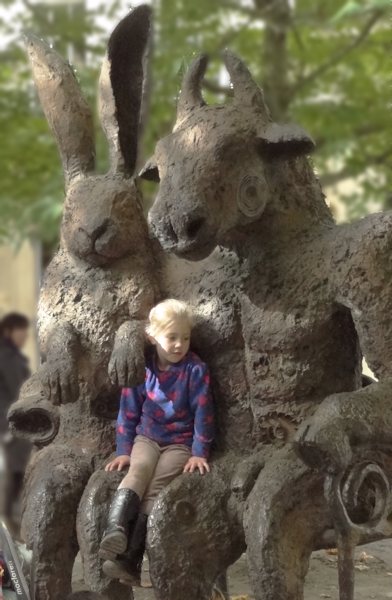
I've always liked and admired SophieRyder's work – both artistically and polemically (she is one of the few who successfully pull off that combination without selling one of them short).
And children are usually intrigued by her playfully tactile incorporation of recognisable industrial detritus into organic forms (for instance, her frequent use of chain to represent spinal structure).
Seeing this child (click for a larger view) nestle so happily and naturally into The minotaur and the hare, though, is a new thing to me – seeming to simultaneously enrich, clarify and validate Ryder's vision.


10 October 2012

Where is Iron John?

Several good exhibitions coming up, which I am eagerly looking forward to visiting.
The first, Where is Iron John? by AcerOne, is in London, opens with a private view tomorrow (11th October) evening and then shows for three days only – so, if you are within reach of Brick Lane on the 12th-14th, seize the chance to see it while you can.
[Post script, 12th October: I made my own visit to the show today, was as impressed as I knew I would be, and bought my own tiny little piece of it.]

24 August 2012

Finding Helen

I'm too much a scientist to give a moment's credence to the idea that coincidences have any significance; but human enough, at the same time, to enjoy (even as I dismiss it) the superstitious illusion that they might. A coincidence takes at least two components. This one has three: a place, an object, a book title.

I was last in this place, this city of absurd architecture, forty years ago give or take a week or so. I had come to visit a friend, but the hitching had been too slow to arrive at a time when I might still have reasonably knocked on the door. No lights were on, so I wandered down to the beach and curled up on shingle amidst the suck and blow scraping sound of surf beneath a jetty.

A coincidence also requires at least some element of unlikelihood, though this is subjective. Being in a place I have been before would, of course, score nothing at all for improbability; perhaps, though, the nearness to a four decade anniversary can be said to count.

The friend was Helen; I had known her since I was fifteen, though the friendship was maintained mostly through letters (our families were both peripatetic). Real meetings like this were infrequent though always natural and easy. It began as that preciously rare thing, at least for me (a boy at an all boys school): a friendship with a girl which didn't, at some level if only in subconscious and unrequited fantasy, involve any sexual dimension. Now, five years later, we were both students in different places a long way apart; this visit was one of the occasional renewals in person.

Next morning, when the sun had been up for a decent interval, I knocked at the door and, of course, both Helen and her parents scolded me for not having woken them. I spent a carefree few days there, then hitched out again. I saw Helen again, after that, but not here. She met a fellow student whom she would spend the vacations; I liked him, and he made me welcome in their home just as her parents had. Eventually she married, and so did I. She moved, and so did I. We lost touch. When I tried to find her again, through her parents, they too had moved and the trail had gone cold.

Now, forty years on, I sleep not on the shingle but in a comfortable hotel room. I shall, later in the day, catch an onward connection.

Wandering through the snaggle of little streets which make up what is a cross between hippy quarter and trendy tourist trap, I drift on impulse into a large premises containing a mix of small dealers on the scale from junk to antiques. A number of the displays contain significantly overpriced old cameras, which interest me, so I stop to look a them through their glass cases.

There are large numbers of old amateur folding bellows type portable cameras designed for 6cm roll film, though none of them is the fondly remembered childhood "sixteen on" Dalmeyer which might (despite the inflated price tags) make me consider buying. There are a couple of Ensigns: one in moderate condition and one, inexplicably more expensive, badly battered, corroded, decrepit. There are numerous Kodak Bantams, Brownies and Bullets, Ferrania and Ilford equivalents in Bakelite and plastic, Agfas and Arguses ... and, incongruously in their midst, a single spruce looking SLR: a Praktica LTL.

On that last visit here, forty years ago, Helen asked me to help her buy a camera. She needed one for her course, wanted it to be good enough to continue usefully into her subsequent career, but didn't know enough to make a confident choice alone. She liked my own Pentax Spotmatic, but couldn't afford to buy one of her own. The compromise we found was a Praktica LTL, which she carried home with an unrestrained delight that made my heart glow.

That the only SLR (indeed the only modern styled and technologically sophisticated camera of any kind) amid the dozens of older and simpler examples should be this particular make and model is, I think, as sufficiently unlikely to qualify as a component of coincidence.

Though aware, in the filing cabinet at the back of my consciousness, of the four decades old connection, it's not been on my mind and I have given it no thought nor attention. Looking at the LTL sitting there behind the glass of its case, amidst the worn and dusty relics, in perfect "as new" condition as if straight from the shop back in the summer of 1972, I suddenly feel the connection move from filing cabinet to heart.

The third element of today's coincidence is that this morning, before breakfast, I started reading a Colin Greenland novel. I am half way through it, and will finish it before the day is out. What is unlikely about reading a Colin Greenland novel? Nothing in itself, but I have only read one before: Other voices, from whose title I ripped off the heading for my blog roll on the left of this page. Despite being so deeply impressed by it that I have reread it at least a dozen times, and have for the past twenty something years been meaning to explore his other work, today is the first time that I have started another. And the one upon which I happened to alight when I bought it, picking from an Amazon list a week or more ago, is called Finding Helen.

The coincidence lies purely in the title, not the content, of the novel (though it's a powerful and engrossing novel; I recommend it).

Greenland's Helen is a petty, vindictive, malicious, self obsessed, narcissistic, life devouring monster. Mine was the opposite of all those things: warm, generous, funny, gentle, unselfish, with a ready smile for the joys of others and an impish grin always ready to break out at any of life's peaks or troughs.

Greenland's protagonist is a broken reed, abandoning his present life in pursuit of an illusory past. That's not me, either; I have no intention of chasing off on a fool's errand to track down and locate someone I used to know, half a lifetime ago when we were both different people.

And yet, through this three segmented coincidence, "finding Helen" is exactly what I have, inadvertently, done. She's been stored away too long in that dry filing cabinet; I'm very pleased to have found her, and to have her vivacity back in living mind where it can warm my world.


  • Colin Greenland, Other voices. 1989: Unwin Paperbacks. 0044403097 (pbk)
  • Colin Greenland, Finding Helen. 2002, London: Black Swan. 0552770809 (pbk.). [Amazon Kindle link]

22 August 2012

Symphony

Crossing flat rural lowlands by train, I'm watching the aerobatics of a starling flock preparing to roost.

I know the research results and mathematics of this phenomenon; I have photographed and filmed it many times; I have played with Boids. These are enriching ways to explore it, but can never capture the wonder.

I've mentioned before the privilege of seeing Dublin artist Sue Bamford's working records. Amongst pages I've seen recently is this wonderful drawn and grated charcoal impression of the feeling of a flock, reproduced here with her permission.