Showing posts with label Women artists. Show all posts

20 January 2013

Don't marry her...

Camille Claudel is, to my eyes, a far better sculptor and greater artist than Auguste Rodin; her work is consistently warmer, more imbued with emotion, more genuinely passionate. That she is less celebrated is partly a result of the breakdown and subsequent incarceration which cut short her career in middle age, partly the perennial problem of female artists being consistently written out of art history by a male establishment.
A very good and thought provoking recent lecture, in which the mutually dependent/destructive symbiotic/antagonistic artistic relation between the two was the focus, has had me mentally revisiting their work and the interaction which it displays. A meandering journey which brought me to Claudel’s L’Age mûr and paused there.
L’Age mûr is usually seen as a despairing autobiographic public cri de coeur in the face of Rodin’s refusal to leave his lifelong partner Rose Beuret. In this interpretation, the elderly woman at camera left is the implacable fate Clotho (representing Beuret) leading the unresisting central male figure (Rodin) away from life in the form of his younger lover (Claudel) who pleads on her knees at camera right.
Looking at the sculpture today, it suddenly merges in my mind with the lyrics of a song: an equally passionate and doomed cry of anguish from a lover who also finds that she cannot use youth and flesh to overturn more compelling loyalties.
The song is Don't marry her, sung by The Beautiful South. There are two slightly different versions, the original release and a later radio edit which (this being a family show, and since either would equally do for my present purposes) I've decided to choose here:
Think of you with pipe and slippers
Think of her in bed
Lying there just watching telly
Think of me instead

I'll never grow so old and flabby
That could never be
Don't marry her, have me...
Melded together, as they now are, sculpture and song both appear to me in a sadder and kinder light.
Of course there's nothing unique in this context about these two particular pieces; it just happened that way. I could equally well, perhaps, have alighted on Tracey Emin's Everyone I have ever slept with 1963–1995 tent and Alanis Morissette's You oughta know...)

  • Paul Heaton and Dave Rotheray, Don't marry her. 1996 (quoted radio edit: 2002)

02 October 2010

Just deserts

According to Richard Lederer’s unnamed student[1], deserts are defined by a climate "such that the inhabitants have to live elsewhere" and have to be "cultivated by irritation". Say the word desert to most people in the industrialised west, and they will visualise somewhere hot, sandy, and utterly devoid of any life except, possibly, Peter O’Toole and Omar Sharif striding (with or without camels) across photogenic dunes.

In the days when I was trying the patience of successive O-level geography teachers, we were given a more seductively precise and objective definition: annual mean rainfall of 250mm or less. That figure is still around, although it has generally been supplanted by more sophisticated relative concepts like relative moisture economy deficit (more water lost through evaporation and transpiration than is received in precipitation).

Generally speaking, the most widely used climatological classification systems go by distribution of vegetation, which both serves as an indicator of available water and decides the viability of other life. This approach naturally appeals to statistical data analytic bean counters like myself, though they do complicate matters by including temperature considerations. A desert, for my purposes here, is a region whose available water economy provides marginal (or nonexistent) support for life. It will usually be arid, but we won’t be too picky about semiaridity distinctions as many of the problems to be studied involve transition. It will often be megathermal, but not necessarily so.

Oceans cover about two thirds of the earth’s surface. Deserts account for roughly two thirds of what is left (and current trends, despite significant efforts at reversal, are towards net increase) so they are no small matter – either in themselves or in the computational challenges which they can present. It is not much of an exaggeration to say that only since the explosion of generally accessible scientific computing resources can they be realistically confronted at all. [More]


  1. Lederer, R., Anguished English : an anthology of accidental assaults upon our language. 1987, Charleston: Wyrick. 0941711048 (pbk.).

17 September 2010

Lunch date

With (unusually) time to spare near Manchester Square, I've spent a quietly pleasant hour renewing my acquaintance with Madame Perregaux.

No reproduction, ink or digital, can ever match the physical presence of paint.

01 July 2009

The obstacle race

It's with very great pleasure that I see Ray Girvan at JSBlog highlighting the blatant marginalisation of women in western art history. Writing this on the wing, I have neither the reliability nor the bandwidth to follow his link immediately but will do so later when opportunity permits.

When I recently muttered about the “great man theory” of history popping up everywhere, including popular music, I received several emails gently suggesting that such and such person had been a turning point. Putting aside the distinctions between being, or marking, or representing a historical point of inflexion, I think some of these correspondents felt that I was devaluing the influence which an iconic individual had upon them. Nothing could be further from my intent. I cannot agree that Janis Joplin (for example) or Joan Armatrading (to take another) changed the course of music; but both of them certainly influenced me greatly, becoming the vector through which the spirit of the time acted upon me, and my life would be different today if I had not heard each at a particular place and time.

As I've mentioned before, an early siren calling me into the arts was Elisabeth Louise Vigée-le-Brun. In exactly the same way, I would never say that she changed the world: but she is a hero to me, and her Countess Golovin wrought a crucial change in my life. I chanced across her in the early nineteen sixties, then never encountered any other women on the painter's side of the canvas in any of my subsequent art history education. My (now ex) wife (a passionate painter, sculptor, historian and feminist) a decade and a half later, prompted me tothink about this ... why is the work of Sofonisba Anguissola, Paula Modersöhn-Becker, Rosa Bonheur, Suzanne Valadon, Käthe Kollwitz, Gwen John, Artemisia Gentileschi ("the magnificent exception" of Germaine Greer's The obstacle race , a few years later), Kay Sage, Natalya Goronchova, Mary Beale, Françoise Duparc, Mary Cassatt, never covered in conventional western art history...?

As Ray says, the restitution is still only partial. Many of those women artists are head and shoulders above the male contemporaries who have eclipsed them. That Gentileschi's astonishing work should for centuries have been attributed to her pedestrian father Orazio is laughable. I recently won an easy bet because an art historian I know (and, in general, deeply respect) refused to believe that a Judith slaying Holofernes was by Gentileschi and not Caravaggio (teaching and received wisdom are very effective blinkers; once persuaded, he willingly agreed that Gentilieschi's rendition was infinitely more powerful than Caravaggo's, and he didn't know why he'd never seen that they couldn't be from the same hand). Women artists are still not represented in art school or university art history curricula in anything like proportion to their number. Few people, watching Night at the museum 2 or visiting the US Capitol Rotunda, when asked to guess who produced the massive statue of Abraham Lincoln (the work of a teenaged Vinnie Ream Hoxie) come up with s female name.


  • Germaine Greer, The obstacle race : the fortunes of women painters and their work. 1979, London: Secker and Warburg. 043618799X

02 February 2006

Affective magic

Coming back from the months away, I seem to be in a close orbit around Jim Putnam’s blog; but hey, there are worse orbits to be in, and I’ll boost clear as the old muscles get used to being used again.

Jim comments, as part of a post on the theme of change, on a Domenichino sybil which has hit the sweet spot for him. He doesn’t specify exactly which of the sybils it is but from his description I’m fairly sure it’s the 1616/1617 Sibilla, though it could be the very similar Sibilla Cumana of 1610.

My interest here is the way such images reach across centuries to touch hearts, and the similarity between that reaching and the similar touch of faces in the here and now. Why does one face capture us, become the key that turns our personal lock, and not the sea of others?

Jim’s Sibyl does nothing for me; that doesn’t matter, all that matters is that she does for him. And I can see why she reaches him – the edge of her gravitational field tugs at me even though it fails, in the end, to capture me. Domenichino himself shows evidence of being captured by particular faces: the model who posed for the later 1622 version of Sibilla Cumana appears in other paintings which he did around the same time (as St Agnes, for instance).

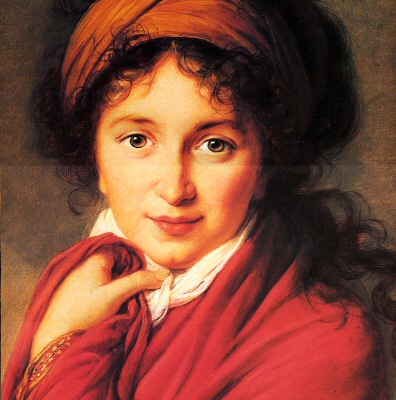
When I was about twelve years old, while other boys were fantasising about Diana Dors, Marilyn Monroe, or Jayne Mansfield, I fell hopelessly in love with the Countess of Golovin, as painted almost two hundred years later by Elisabeth Louise Vigée-le-Brun. (That's her at the top left of this page: a detail from the painting. Click it for a larger view.) I had a lot of fun poked at me over this, and learned to keep it quiet from my friends; but the small poster which my parents obtained from somewhere or other stayed pinned to the inside of my wardrobe door or somewhere equally discrete (getting steadily more battered and frayed) until I finally lost it somewhere in my late teens or early twenties.

Vigée-le-Brun’s Golovin still hypnotises me now, forty years on, and with adult insight I can say why: it’s the vivacity of personality coming through, and especially the way it comes through those extraordinary eyes which look frankly out at you.

So is it just the eyes, then? Apparently not … I tried cropping out the eyes from my Golovin and all three candidates for Jim’s Sibilla, and laying them out together on the screen, and all of them became equally lifeless, leaving me equally untouched.

I went back to close cropped faces, all surroundings eliminated but the complete face of each still visible. Golovin’s magic was back with full force, and so was the perceptible almost pull of all three sybils. I studied the other details. I found that I don’t like the sybils’ mouths (too small, too red, too cupid’s bow) but Golovin’s is pleasing. Cropping down to just the mouths, though, all of them again left me equally indifferent.

So, it’s something in the totality of the way that particular components interact which produces this magnetism which draws Jim to the sybils and me to Golovin. I know that it is humour, intelligence, and eyes that draw me in real, living human beings (male and female, old and young; this is not sexual attraction I am talking about although it plays its part in that too); looking at Golovin, I find that the vivacity I mentioned contains both intelligence and humour. Actually, intelligence is not strictly the word I mean … “interestedness” is closer: a quality of inquisitiveness, of wanting to know about the world and all that is in it.

So … where has all this gotten me? Nowhere in particular, really, I suppose; but I enjoyed the journey. Sorry if you enjoyed it less – but then, if that’s the case, you probably abandoned ship some time ago...

(Later addition: Jim takes this further in a post under the same title.)