Loading...

30 May 2011

How beautiful is the rain...

Rain streams across a hotel window and breaks the street outside into a rippling impressionist geometry.

Rain on a window unfailingly triggers in my bed the recitation of a single stanza from a poem, in a classroom forty nine years ago.

The sick man from his chamber looks
At the twisted brooks;
He can feel the cool
Breath of each little pool;
His fevered brain
Grows calm again,
And he breathes a blessing on the rain.

The poem is Longfellow's How beautiful is the rain! and this is the fourth stanza of eleven.

Curious that an eleven year old should have felt such empathic pull from an image and an idea that meant nothing to him from his own experience ... and continue to feel it as a permanent and consistent association across the next five decades. I would have expected the opening line pairs from stanzas two and three to be the ones that stuck, because they are instantly recognisable – and stanza three ties very specifically to the visual image which I associate the poem:

How it clatters along the roofs,
Like the tramp of hoof
... ... ...
Across the window-pane
It pours and pours;

But the mind is its own master, and stanza four is what has stayed with me across the gulf between then and now.

(Possibly the fact that I learnt the poem in the classroom of the monstrous Mrs F has something to do with it. Mrs F was the class teacher from hell – literally, perhaps, to judge by her constant warnings of fire and torment in the afterlife. Maybe I sat in the whiff of sulphur and brimstone, imagining the release of cool rain? But no ... I suspect that this is a fancy constructed well after the event, a poetic rationalisation of the past from a psychologically aware adult future.)

The whole poem, to be honest, has little appeal for me as an adult ... I left it behind about five years after I first heard it ... but that single stanza remains mnemonically wedded to sight of rain flowing down window glass.


If you want the whole Longfellow poem...

27 May 2011

Move over, Tufty Fluffytail...

Well ... I used to be quite pleased with the squirrel sequence below. But...

...now that I've seen Ray Girvan's Best ever squirrel photo ... well ... mine looks pretty feeble!

19 May 2011

God is in the detail

It's not at all unusual for images on the web (or in other modes of publication, for that matter) to be cropped. It puzzles me, however, that Edward Leighton's very long painting The Syracusan bride is in every case that I have seen cropped to exactly the same very specific extend: removal of the right hand end. Almost everything is there except half a tree, an adult woman, and two children. In the illustration below, I've replaced the missing section (not great quality, but...) with a separating white line to show what is happening.

Why on earth would you cut off just that little bit?

I find the crop even more inexplicable because it vandalises what seems to me the most interesting part of the painting: that group of four bystanders in the bottom right hand corner.

I'm not knocking the painting as a whole. Different pictures do different things for different people. This one holds the key to many people's hearts, and I am pleased for them, but it doesn't, as a whole, float my boat.

That foursome at bottom right, however, are a different matter. They hold three small visual miracles, which call me back to my "Ambushed by simplicity" post a couple of weeks ago. I can't render those miracles here in sufficient quality to be worth bothering; if you are within reach of the Victoria and Albert Museum, any time between now and 12th July, go to the Cult of beauty: the aesthetic movement 1860-1900 exhibition and look at the original. I was there today and took the opportunity of standing in front of that corner of the painting (it's not usually on public show) for an hour.

The miracles are, from left to right: the right hand of the little girl on the left of this group; the man with the beard; and the face of the child on the far right.

14 May 2011

Hurrah – the crabs are back!

Despite unavoidable absence from their natural habitat1 on medical priority grounds, the crabs of Easton MD2 are back.

The results of the 2011 Big Crab Contest have been announced. Congratulations to all participants on this year's magnificent crop of Pleocyematal artworks


  1. *addendum, twelve hours later ... just to confound me, a new sighting in natural habitat waters has now been verified.
  2. **that's MD Maryland and MD Medicinæ Doctor, both.

09 May 2011

Weighting around

Sign in a clinic:

Please weight here until called for your wait check.

06 May 2011

Hearing the colours

Synchronicity, again. Or just the ability of the mind to create connections from happenstance. One or t'other.

In her most recent Unreal nature posts, yesterday and today, Julie Heyward quotes respectively from Jean-Luc Nancy's fascinating Listening and Victoria Finlay's delightful Color (which I have only recently read, to which I keep returning, and for introduction to which I am, as in so much else, indebted to Unreal nature). Between the two postings, but before I had found either, I have also read Joanne Harris's Blueeyedboy – a book with synæsthesia entwined in its black heart.

Would the conjunction of posts drawing on music and colours have triggered thoughts of synæsthesia if I had not just read a book in which a character is cruelly punished for her childhood claim to “hear the colours”? To be honest, I don't know; it feels as though it would, but who can say. Either way, it did and the world is now one in which I see the posts that way. I see both books differently through the lens of Unreal nature's quotations, and differently again through their conjunction with Blueeyedboy.

I shall now have to go back and reread, for perhaps the dozenth time, Mondays are red which (excuse the pun) wrote the book on synæsthesia as metaphor for the agonising confusion of adolescence.


  • Jean-Luc Nancy (trans: Charlotte Mandell), Listening. 1st ed. 2007, New York: Fordham University Press. 9780823227730 or 0823227731 (pbk.)
  • Victoria Finlay, Color : a natural history of the palette. 2003, New York: Ballantine Books. 0345444302.
  • Joanne Harris, Blueeyedboy. 2010, London: Doubleday. 9780385609517 (pbk.).
  • Nicola Morgan, Mondays are red. 2002, London: Hodder. 0340855568.

In the heart of the storm

In the heart of the storm seems an appropriate title for Ray Girvan's latest post, in which he covers the most recent step in his self-set Odyssey through the entire output of Maxwell Gray.

Not just to read, either; to track down, first. And all of this for an author who frequently (see, as one example, A plea for the silence of the novelist) manages to exasperate him. And then to document the journey in fascinating detail for armchair travellers like myself. He originally described this as a project for 2010 ... while the timescale has expanded in practice, it's still both intensive and impressive.

Oh, I have often enough read the entire output of an author ... but never with Ray's combination of intellectual discipline and tenacity. When I think of such a project, my heart quails and I am full of admiration.

05 May 2011

Ambushed by simplicity

Sometimes simplicity of line or shade or colour can reach past sophistication, touch something deep inside, and make you want to cry.

It's happened to me twice, recently: on both occasions, through depiction of a face.

The first, a week ago, was a drawing of a young woman, in graphite on silk, shown to me by my friend Eunice. It was by René David – therefore presumably, though there was no date, about a century ago. The photograph on the left (taken with a pocket compact camera, through glass, in a café) really doesn't begin to do it justice; you'll just have to take my word for the beautiful, soft, pitch perfect delicacy of line and tone in the original which completely undid me.

The second, also showing the face of a young woman, is a detail from a stained glass window (on the right). It depicts St Mary the Virgin, within a window in the cloisters of Gloucester Cathedral. I came there for another reason entirely, and was surprised by this face despite having passed it many times before. The rest of the window, including other faces (for instance, the infant Christ) had no particular effect on me ... but this one face stopped me in my tracks.

OK: I'm a softy. Unrepentantly so.

As usual, click (or double click) either image for a larger view.

04 May 2011

Today

Microclimates are fascinating, beguiling, surprising, thought provoking.

Colonies of alien life, dropped into the unsuspecting midst of ambient ecologies.

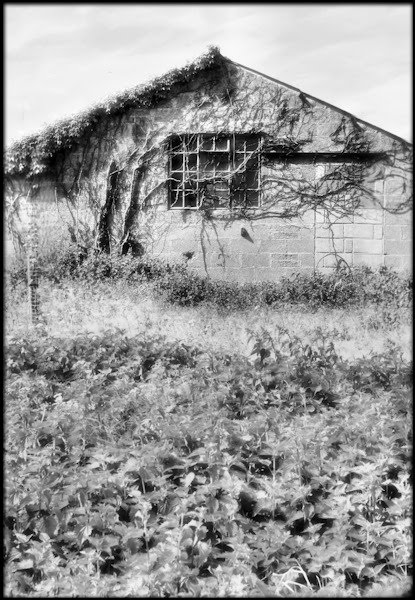
A disused cement block building sits only fifty metres from the blasting storms and vicious winds which come whipping in off the Irish Sea in a lash of spay.

All around it, hectares of tough, hardy, minimalist, scrubby vegetation just barely clings to a marginal salt resistant existence.

In the minimal windbreak shelter which it affords, an island of comparatively softer inland weeds flourishes.

Among them, this lush stand of nettles: like an insular expatriate community, oblivious to the realities of life about them in a foreign land.

01 May 2011